Monday, July 15, 2013

A garden

I’m going to be getting my hands dirty, and I’m excited about it.
Larry and I are planning to build raised beds in our backyard for a vegetable garden next year. We’ve walked the yard and decided where to put it. We’ve talked about size and design. We’ve discussed dirt. We’ve considered how to keep the wildlife from eating everything in it.
We’re making plans for a garden.

Site for our raised beds. Larry's shop and a tool shed are in the background.

At one time, I never could have written those words and been happy about them. I was so consumed by fears of contamination that I engaged in compulsive hand washing that left my hands and wrists red and raw. I avoided anything that might get my hands dirty, including garden dirt.
My fear of contamination was rampant when I was a teenager and young adult. Over the years, with treatment for OCD, my fears have greatly subsided.
I’ve even had flower gardens and potted plants. I enjoyed working in the dirt and watching plants grow.
So why haven’t I taken the next step and put in a garden before now? I grew up on a farm, after all. My parents put in a garden every year, usually a huge one. They always planted extra in case neighbors or family didn’t have a good year.

My parents' garden on their farm in rural Virginia in 1985.


Another view of my parents' garden, circa 1985.


My parents' garden in 1988.

Larry and I have talked about putting in a garden. One year we even grew tomato plants. Unfortunately, the deer and groundhogs ate all but a few of them.
What has really kept us from moving forward has been my reluctance to commit to it. One way depression affects me is to drain every bit of motivation out of me. I become married to just a few activities that don’t take a lot of energy and don’t ask too much of me.
Even when depression is treated with medication and therapy, old habits of procrastination and complacency die hard.
But this year of contemplating “letting go” has led me to want to do more, to not waste time.
So along with getting good treatment for my depression, I’ve been making more of an effort to do things.

Unbeknownst to me, Larry started researching raised beds. He began thinking how he could build the frame, how he could build a fence around it. A couple of weeks ago, he broached the subject to me and since then, the ideas have been percolating.
We’ll build it this summer or early fall, then nurture the soil to get it ready for next spring. I’ll have to do some research to figure out what to plant and when to plant things.
Having a garden to care for will be a challenge for me. I will have to work in it whether or not I feel like it.
But I know it will also give me a sense of accomplishment. It will give me a much-needed connection to nature. And it will give Larry and me fresh produce to eat and share with others.

Do you have a garden? If so, do you grow flowers, vegetables or both? What do you enjoy the most about having one?


Friday, July 12, 2013

Disjointed week


That’s what this week has been: disjointed. Busy, bored. Busy, bored. Worried, calm. Worried, calm. Just one of those weeks that jumped and started.
My Random 5 kind of matches my week. I don’t have an overall theme, so these are rather disjointed thoughts that came my way as I sat down to write this.
I’m linking up with Nancy’s A Rural Journal for Random 5 Friday. Link up and join the fun!

One
Rain. And more rain. Nearly every day, we’ve gotten rain here in Central Virginia. Even when it’s not raining, the air feels heavy with water.
We’ve had dry conditions for a number of years, so we welcome the water. But so much has made the ground sodden, and conditions are ripe for flash flooding.
It’s pouring rain as I write this Thursday evening, and there are news reports of area flooding. We’re OK where we are, but my thoughts go out to those affected by it.


Two
I spent a good two hours Thursday evening looking for a photo. I know it’s here somewhere, but I couldn’t find it. I sifted through pictures I’d forgotten I had.
For example, I barely remember visiting Poplar Forest, Thomas Jefferson’s retreat in Bedford County, years ago. But I found a whole packet of photos I took while there.
And I found the photo I’ve included in this post. I took a journalism/graphic arts class my senior year in high school. We were allowed to borrow the school camera (a 35 millimeter) to take photos to develop in the school darkroom.
One of the photos I took was of the old mill in the rural area where I grew up. You can’t tell from the black and white photo, but it was a painted red. You could give people driving directions by mentioning “the old red mill.”


Three
The picture I wanted to find—the one I didn’t find—was of my first car, a Ford Maverick. Kathy at You’ll ShootYour Eye Out and I found out this week that we both owned a Maverick as our first car.
That connection made me think about that car, and I wanted to see it again.  
I have no visual for you, but mine was a 1977 model, light gray with red interior, with an 8-track player. I bought it in 1983 and kept it for two years.
What was your first car?


Four
My current car is a Pontiac Vibe and has over 100,000 miles on it. 100,298, to be exact.
I am so disappointed that I didn’t notice when it tripped 100,000. I was going to get a picture of it.
They don’t make them anymore, but this car has served me well, and I still enjoy it.


Five
Work at the newspaper has been slow. We have slow times throughout the year, but July is historically slow.
My service date is coming up, and I checked with our HR department to see how much unused vacation time I had. I discovered I had more built up than I thought I did. So with my editor’s blessing, I decided to take next week off. I wasn’t sure if I should at first, but my stories for next week lined up nicely.
I’m looking forward to being off!
  If you suddenly had a week stretching out in front of you with no obligations, what would you do?


Wednesday, July 10, 2013

Visitors from Japan

Tiny painted dolls from Japan sent to me by my father's Army buddy about the same time this story took place.

This story becomes a different story when I consider what I knew then and what I know now.

What I knew then:
I was about 7 years old, and it was suppertime. My brother closest to me in age—two years older—ran with me into the house at my mother’s call, and we began to wash up at the little sink in the corner of the kitchen of our farmhouse.
I could tell my mother was not in a good mood. She was frowning, she wasn’t saying much, and she moved quickly to place bowls of food on the table, letting them slam a bit as she set them down.
I knew better than to say anything, so I just joined the rest of the family at the table.
Later in the evening, my parents told my brothers and me the news: one of Daddy’s Army buddies was sponsoring two Japanese students on a tour of the United States, and he wanted to know if the young women could stay at our house for a few days. Mama and Daddy had said yes.
I was ecstatic. Company! And two girls, college aged! And they were from a foreign country! What could be more fun?
My contamination OCD hadn’t touched me yet, so I had no concerns about strangers in the house or strangers using the bathroom.
So that summer Yoko and Famiko stayed with us for several days. They were wonderful guests, kind, always eager to learn something new about the U.S.

Key ring given to me by Yoko and Famiko. Its woven ball has a bell in it.

I followed them around, awestruck at being around college girls who came from a place far away.
We showed them around the countryside. They were interested in the crops that we grew, especially the tobacco that many of the farmers in the community still raised back then. We took them to some nearby sights, including Natural Bridge.
When they left, I went with the rest of family to see them off at the bus station. My mother gave them each a tube of hand lotion.
When we got home, I remember my mother immediately tearing off all the bedclothes from the beds they had used and washing them.
Yoko and Famiko sent us Christmas cards for a few years after that, sometimes with little crackers included, sometimes an origami figure.

What I know now:
My mother did not want the Japanese college students to visit us.
It was only years later that I connected my mother’s bad mood on the evening we found out about their visit with her feelings about having them visit.
She was a teenager during the years the United States was involved in the conflicts of World War II. She harbored resentment against Japanese people, even though the war had been over at least 25 years by then.
My father was a World War II veteran. He served as a medic in the Pacific Theatre. He was wounded in battle.
But he made the decision that, despite my mother’s resistance, we would host the two Japanese college students.
I don’t know why Daddy was so willing when my mother was not. My mother told me once that part of the reason was because Daddy thought so much of his Army buddy.
What strikes me as impressive, though, is that neither parent discussed any of their possibly conflicted feelings with my brothers and me. My mother never said anything about not wanting the young women to visit.
My parents treated Yoko and Famiko with respect and tried to make their visit fun and educational.

It’s a better story with what I know now.


Have you ever had visitors that changed your view of the world?

Monday, July 8, 2013

OCD and a sense of guilt

My father, Christmas Eve 1996.

He couldn’t speak anymore, but he could mouth words enough to be understood.
“Worried,” he said.
I stood by his bedside, looking down into his face. He stared back up at me.
“What are you worried about?” I asked.
“No food in . . . “ and he held up the fingers and thumb on one hand and one finger on the other hand to signify six. “. . . weeks.”
My father had gone into the hospital in May 1997, through the emergency room. He had uncontrollable vomiting. Nothing would stay down.
Tests showed that a flap in his stomach that was supposed to close after eating was remaining open. The food wasn’t processing through his intestines. It was coming back up.
The doctors thought it was likely caused by continued damage by strokes.
Some medication had worked for a short time in helping him keep food down. But eventually, it didn’t work. To get him some nourishment, the doctors had surgically inserted a feeding tube that bypassed his stomach.
He was in a nursing home because the level of care he needed just couldn’t be given to him at home.
But now in late June, he was back in the hospital because he was dehydrated. And he was looking to me for answers.
He never took his eyes off my face.
“Yes, it has been a long time. But we’re hoping that this feeding tube is temporary,” I said. “We’re hoping that you’ll be able to eat again, and you’ll be able to go home.”
I can hear my voice now, 16 years later. Cheery. Bright. Hopeful.
And I did have hope. I wasn’t trying to pass along false hope.
Daddy nodded his head and didn’t say anything else about it.
Back at the nursing home, his health continued to deteriorate.
He died on July 9, 1997.

I struggled with that conversation in the hospital for years.
Plain old-fashioned guilt would have carried me along just fine. But my OCD made it worse.
I obsessed over my words to him. What could I have said differently? How could I have said it differently? What could I have done differently? Had I not done enough?
After almost a lifetime of OCD compulsions to try to protect my family, had I ultimately failed and let my father die?
OCD wants you to feel guilty. It wants you to question yourself about things over which you have no control, over things about which there is no certainty.
It had an easy target in me.

But I outwitted OCD. I was already on medication to help it, but I did more. I learned much more about OCD than I ever thought there was to know, and I learned ways to work with it, to work around it. I followed self-help guidelines. I got therapy that targeted OCD.

I know now that I did the best I could. I shared with Daddy the hope I had. He was a smart man. He knew what was happening to his body. He wasn’t looking for me to give him a definitive answer. He wanted to talk with me and share his concerns.
And he wouldn’t want me to feel guilty.

Friday, July 5, 2013

I need a hobby: A Random 5

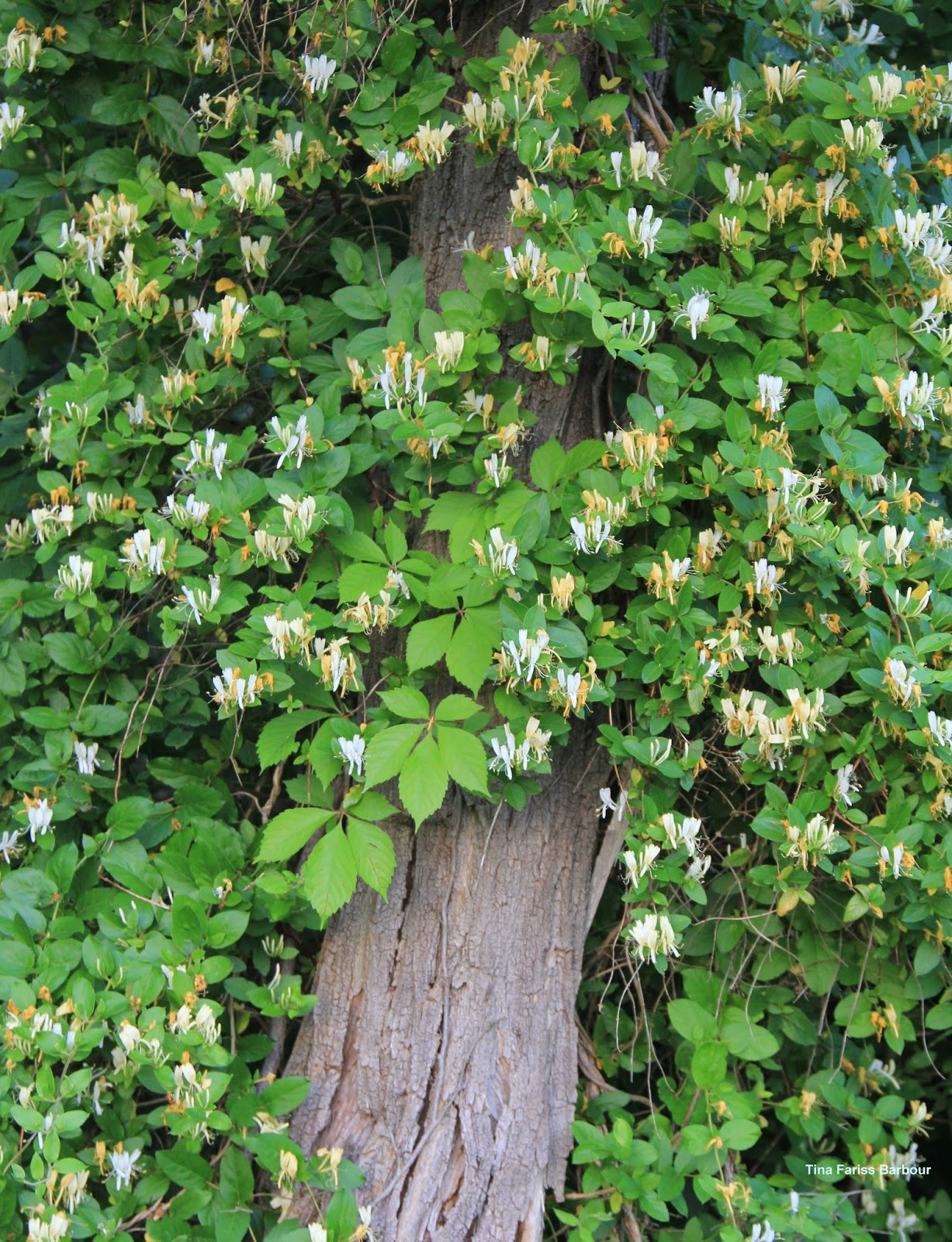
Honeysuckle on a tree, Leesville Lake, May 2013

The other day I wandered around a big box arts and crafts store, looking for a project to do. I walked out of the store after buying nothing.
I looked at so many different crafty things to do. I looked at cross stitch kits. I looked at yarn. I looked at art supplies.
I even looked in the children’s craft section to see if anything there appealed to me.
I couldn’t seem to get excited about doing anything.
I write a lot. Writing is my first love as far as activities go. I take a lot of photos. I read a lot.
But I need a hobby. I need something to do that helps me relax, challenges me, and gives me the sense of satisfaction that completing something does. I need some other ways to be creative.
Nothing seems to suit me. Maybe I’m just in a creative funk. Maybe I need to try something totally different.
My five random facts this week tell you what I’ve tried out in the past and still do sometimes.
I'm linking up with Nancy at A Rural Journal for Random 5 Friday.

One
I started piano lessons when I was 5 years old. I had been picking out tunes on our old Kurtzmann upright, and my mother wanted me to learn to play by note.
I took piano for seven years and organ for one year. When I was 13, I got tired of practicing and asked if I could stop.
I have a keyboard now, and when I play, it’s by note and by ear. I just play for my own enjoyment. And Larry and the kitties seem to like it.


Two
When I was 8 or 9 years old, my mother took crochet lessons. She taught me what she learned, and she also took me to class one evening. I started out making potholders.
When I grew older, I became capable of making baby blankets. And I’ve made some smaller pieces that my kitties have used to lie on.


Three
I took sewing lessons when I was about 14 years old. I made a skirt. That’s the last thing I’ve created except for some pillows.
I have a nice sewing machine that Larry gave me several years ago. But I can’t seem to get the hang of sewing. I can’t figure out the steps to take and how things go together.


Four
When I was in my early 30s, I took a drawing class, the only art class I’ve ever taken. I had to concentrate and work really hard. I didn’t draw well, but I did get better.
The only drawing I’ve done since are mandalas, which I like to draw and color.


Five
I started cross stitch when I was laid up after bunion surgery about 15 years ago. I obviously didn’t read the directions closely enough on my first project because I did the outlining first. My sister-in-law gently pointed that out to me when she saw my first efforts.
I enjoy playing with the colorful floss and creating pictures. I also enjoy the quiet rhythm of pulling the thread in and out of the cloth.

What are your hobbies? How did you discover that you liked doing those things? Do you have any ideas for me? Suggestions are welcome!


Wednesday, July 3, 2013

Take the time to stop and smell the roses--or cuddle with a cat

Sometimes you can have a world of things to get done. Chores, errands, a long to-do list. Important things, to be sure.
Then another creature calls for you, needs your attention. Right now.


Or there’s a bit of beauty to be enjoyed. Right now.


And all the things you have to do go out the window.


And everyone is happy. Everyone relaxes. Everything eventually gets done.

What helps you slow down and enjoy the moment?

Monday, July 1, 2013

Reassurance: when it’s not a good thing

I think of my father almost every day, if not every day. But this time of year, the months that coincide with his last illness and his death 16 years ago, I think of him very often.
So if I write some posts that include stories about my father, you’ll understand why.

My father, circa 1994.

It was late June or early July 1997. I was hunched down over the phone in my cubicle at work, talking with my sister-in-law.
“Do you think Daddy’s going to get better?” I asked her.
“No,” she said.
Her answer shocked me. All I could say in response was something like, “Oh.”
But I knew she had told me the truth.

I had sought reassurance from my sister-in-law, but in truth, I’d been seeking reassurance from everyone around me for weeks. I wanted someone—my mother, one of my brothers, the doctors—to tell me that my father was going to be all right.
I wasn’t interested in the truth as much as I was in being soothed and comforted so I wouldn’t have to feel the worry and anxiety that beat at me all day long into the night.
I recognize now that it was OCD making me search frantically for reassurance, making me ask question after question of the doctors or family members who had spoken with the doctors.
One of my chief forms of OCD is harm OCD, where I obsess over harm that might come to my loved ones.
I used to perform compulsions like hand washing; prayers that turned into continuous, silent chants in my thoughts; and checking to try to get rid of the anxiety about someone getting sick or dying.
I also sought reassurance from others. If others could tell me that everything was going to be all right, then I could relax. I could let go of the anxiety, even if for a while.
Besides questioning others about their health, I also sometimes depended on others to tell me that the light switch was off; the stove was turned off; there was a stick in the path, not a nail.
Seeking reassurance was a compulsion for me.
Those of us with OCD have to learn that we can’t depend on the reassurance of others to make it through anxiety.
We have to learn to be honest with ourselves: We can never be certain of everything.
Whatever drives our OCD—concerns about harm, contamination, completeness, perfection—cannot be permanently sent packing because someone else tells us it’s going to be OK.
We have to stop doing the rituals that are supposed to get rid of the anxiety.
We have to learn to deal with the anxiety. We have to learn to accept uncertainty.
It’s hard. It’s an ongoing process for me. I still prefer someone telling me that everything’s going to be all right. But I know that’s not the way to get past the grip of OCD.

On that summer day in 1997, my demand for reassurance didn’t work. My sister-in-law was a nurse aide and worked in the nursing home where my father was a patient. She had seen others in the nursing home who had grown sicker, who had died. She knew things that I didn’t, recognized things that I didn’t. I knew she was right.
My father was not going to get better.
And I had to accept that. No one could reassure me out of that.