Showing posts with label therapy. Show all posts

Monday, March 23, 2015

Book review: Overcoming OCD: A Journey to Recovery. By Janet Singer with Seth J. Gillihan.

Today I have the pleasure of reviewing a book written by a woman who I met through blogging and who has inspired me with her advocacy for educating others about OCD.


The book is Overcoming OCD: A Journey to Recovery, by Janet Singer with Seth J. Gillihan.
Janet writes a blog called ocdtalk, where she discusses her experiences as a parent of a son with OCD and their journey to find help. She also keeps readers updated on research being done on OCD. And she is an advocate for Exposure and Response Prevention therapy, the leading therapy for OCD.
In her book, Janet writes about Dan’s journey from being unable to eat, from lying on the floor for days at a time, caught in the snares of OCD, to reaching a diagnosis of “mild” OCD and being able to have a fulfilling life.
Dr. Seth J. Gillihan is an expert in treating patients with OCD and other anxiety disorders. In addition to having a clinical practice, he is a clinical assistant professor of psychology in the Psychiatry Department of the University of Pennsylvania and a visiting assistant professor of psychology at Haverford College.
Gillihan gives readers the “facts” about OCD: what it is, what the symptoms are, what treatments are available, what problems people seeking treatment might face, and more.
The abiding theme of Overcoming OCD is hope. But Janet isn’t feeling much hope when her story begins. Her son Dan has struggled during his first year of college, and Janet visits him to try to help.
She is shocked by his haggard appearance and his obvious anxiety. And she is shocked when they reach the motel where she is staying, and he is unable to climb the concrete steps up to the second floor.
Step by step, slowly, she helps him up the steps. Then he says he’s unable to come into the motel room. She pulls him into the room.
“And so our journey began,” she writes (p. 2).
Janet knew her son had OCD, but she had never seen it manifested in such debilitating ways. Dan couldn’t eat, couldn’t use his cell phone, couldn’t drive, and couldn’t go to certain places. His promising future in animation—a dream that he had had for years—seemed in jeopardy.
Janet and her husband Gary and the rest of their family rallied around Dan and supported him on his road to recovery, which was never linear and never easy.
Dan spent about nine weeks in a residential OCD treatment center, and Janet and her husband struggled with staff who seemed to be leading Dan to a life of lower expectations. The treatment center did give Dan a good foundation in ERP therapy, providing him with tools to fight his OCD.
The family moved to Dan’s college town so that they could be there to support him. He saw a number of doctors and was on a number of medications. Side effects of some of those medications put Dan into a medical crisis and delayed his recovery.
Janet learned to speak up and ask questions of Dan’s caregivers. She did her own research. She interviewed perspective doctors to find the right fit for Dan. She supported Dan in the tenuous dance of being independent but getting the help he needed to fight the OCD.
And she and Gary remained Dan’s cheerleaders and advocates, supporting him unconditionally without enabling him in his OCD.
I read Janet’s blog, so I know that Dan is now doing great, with mild OCD. He graduated from college and has a job that he once dreamed of.
But as I read her book, I felt a taste of the anxiety that Janet and her husband felt as they watched their son sink so low that they never thought he’d come back. I felt the anger at the lack of caring and lack of knowledge that some so-called experts displayed in treating Dan.
I also wanted to reach into the book and tell Dan, It’s going to be OK. I guess that comes from my own experiences with having OCD and having to fight my way to better health.
Janet’s story makes it clear that ERP therapy, sometimes with, sometimes without medication and other therapy, can help those with OCD become more than their OCD. They can live fulfilling lives despite having OCD.
But she shows that one must search for and sometimes fight for good mental health care. Her story makes it clear that there’s still so much education needed of even medical professionals about how to best diagnose and treat OCD.
Gillihan’s explanations are very helpful, especially for those not familiar with OCD.
I really didn’t want to put this book down after I started it. It’s inspirational, absorbing, and just a plain good story.
Parents with children who have OCD would particularly benefit and would be reminded that they are not alone in their journey. The beneficial role that family support can play is well illustrated.
I would also highly recommend this book to anyone who wants to know more about OCD and to those with OCD. I found myself relating to so much of what Dan experienced.
Throughout the journey that Janet and her family took with Dan, family friend and clinical psychologist Mark was a godsend, a person who offered information and hope to the family. In her book, Janet writes, “If you are going to have a mental health crisis in your family, I recommend having a close friend who is an amazing clinical psychologist” (p. 25).
I would add that having a family like Dan’s would help those suffering through a mental health crisis see the light at the end of the tunnel.

Overcoming OCD: A Journey to Recovery is published by Rowman & Littlefield. 2015. For information about ordering the book, go HERE.


Monday, November 10, 2014

Feeling strong physically and mentally

Last week, I “graduated” from physical therapy I was having for a pinched nerve in my neck. I didn’t receive a diploma, but I received a cool T-shirt that says “Physical Therapy Brings Motion to Life” and a sheaf of papers showing me the different exercises I need to continue to do on my own.
More important than any diploma is the strength that I found in physical therapy.

Darius, Katie, and Kyle made up my  PT team.

Different people in my family and in Larry’s family have, over the years, given physical therapy a bad name. In my opinion, they haven’t seemed to take it seriously and have seemed to view it as something to get through—to go through the motions—before what was really desired could happen: surgery.
I was determined that I was not going to have that attitude.
Surgery is sometimes needed. It’s sometimes the best option. But if other, less invasive, options are possibly in the end just as effective, why not try them and give them our best shot?
My orthopedic doctor was very clear with me about my options and even wrote out a list: medication, physical therapy, epidurals, surgery. He circled medication and physical therapy and said we would start with those.
I pointed to the word surgery on the paper and told him I had no plans for that.
“Work hard in therapy, OK?” he said.
And I did. I have done the stretching exercises at home and the movement exercises at PT, lifting weights, pulling on resistance bands, lying on my stomach while I lifted my affected arm over and over.
And I received so much encouragement from the staff at the rehab center. They had such positive attitudes. They challenged me physically and celebrated with me as I became stronger.
And I saw how they treated other patients. Sometimes I could see pain in the faces of people as they struggled to get better. The therapists and assistants were partners in that journey.
At the end of each PT session, I used the cervical traction machine. It was in a room off the main area where most of the therapy was done.
As I lay on the table and had my head pulled away from my neck (sounds painful, but it actually felt good), I could hear sounds from the main room. I heard therapists and assistants asking other patients how they were, expressing sympathy, setting out plans, counting out exercises, encouraging them.
What a positive place to be, I thought.
I still have pain. It got worse after I stopped taking prescription NSAIDS. But it’s not as bad as it was. And my muscles in and around my shoulders and neck are getting stronger. I know more about how my posture affects how I feel.
I had a talk with the main physical therapist on my last day, and we discussed future options. He assured me that I could get better.

That helped strengthen my belief that I have a lot of control in my recovery. There is a lot I can do to get better. And isn’t that true with anything in life, physical, mental, and emotional? We don’t have control over everything, but we can do our best with what we do have control over.

Now I’m going to work on my strength at the Altavista YMCA, where Larry and I are members. My plan is to go over today after I finish at the newspaper office and sort out which machines will work the right muscles. I also have elastic bands to work with at home.
And I am going to get even stronger.


In what ways are you trying to get stronger?

Monday, October 6, 2014

Therapy for the physical, too


I spent a large part of this past summer concentrating on my mental health. Lately, I’ve had to start paying more attention to my physical health.
I’ve had some physical pain for a number of weeks. It started in my right arm, between my shoulder and elbow. I figured I was sleeping too much on that side. I’ve had pain in that spot before, and it went away on its own. Why wouldn’t it just go away again?
It just got worse. It hurt to lift my glass off the table to take a drink. It hurt if I lifted it for anything.
But still . . . why wouldn’t it just go away on its own?
The pain spread to my shoulder and down my arm. My hand felt numb sometimes. The pain made me want to grit my teeth.
I finally went to see my orthopedic doctor last week. I suspected I had bursitis or tendonitis in my shoulder.
The doctor said I had a pinched nerve in my neck caused by osteoarthritis. There’s a vertebrae out of place and some degeneration in the bone.
He wrote out a list: medication, physical therapy, epidurals, surgery. We’ll start with the medication—anti-inflammatory—and the physical therapy and hope that takes care of the pain, he said.
I plan on it working, I told him. I don’t want to have surgery.
I admit, this threw me for a loop. This wasn’t something I could get a shot for and be all better. This would probably be an ongoing challenge.
I even wept a little on the drive back home.


But I rallied and went to my first physical therapy session on Friday. The physical therapist said that even though “there’s a lot going on in there” (my neck), I was getting treated early, which would help.
And then he said something that set me straight.
“We have people come in there who can’t walk,” he said. “Three weeks later, they’re walking just fine.”
Of course, not everyone has such great results. But his statement reminded me that my situation could be far worse. And physical therapy can make a positive difference.


Besides the physical therapy sessions, I’m doing prescribed stretching exercises at home.
I’m happy to say that the pain has lessened.

And I am once again reminded that I have to give my physical health the attention that I give my mental health. It all works together: physical, mental, emotional, spiritual.

So I’m paying attention now.
I’ve been taking some short walks in my neighborhood as a start to being more physically active. The photos today are from those walks.
I’m going to work hard in physical therapy. I’m going to rest my arm and shoulder when I should. I’m trying to be more aware of my posture.

I’m doing my best. And that’s all we can do, right?

Monday, September 22, 2014

Working on it

Changing leaves from a past autumn.

Happy autumn to you, dear readers! It’s one of my favorite times of the year. Perhaps it’s a relic of spending years in school, but the beginning of fall seems like a new beginning to me.

I have been working on getting better since I posted HERE about feeling stuck and full of anguish.

I saw my psychiatrist, and he was concerned about my lack of energy and motivation, my lack of desire to do anything but sleep. We made an adjustment in my medication. It’s one we’ve made before.
It’s too early to experience the full effects of the change, but I have felt more like making plans and setting goals. I am having an easier time starting the day. I am feeling better.

My psychiatrist also thinks it would be a good idea for me to get into talk therapy again to deal with my anger and confusion about my mother. I agreed. I do want to talk with someone nonbiased who can help me find my way through the confusion.
I’m going to see the same psychologist I saw the last time I was in talk therapy. Unfortunately, he doesn’t have an opening until mid-November. I’m on the list to call if he has cancellations, and they did call about an appointment. But it was for a Monday, which are busy days at the newspaper. So, I’ll wait until November if that’s what I have to do.

The idea of taking care of myself, of loving myself, is something I’m still getting used to. It’s not what I was taught to do as I was growing up, and I’ve held on to the belief that thinking of oneself is selfish.
But the time for change is here.
I’m learning more about taking care of myself when I am anxious, angry about the past, or feeling lost.
For example, last week, a particular news story was bothering me. It brought back a lot of bad memories, and I felt tense with anger.
I sat down and wrote down a description of how I felt. I probably frightened the keys on my computer by how hard I was pounding them. But I felt better—relieved, calm—after I finished.
Writing can definitely be therapeutic.

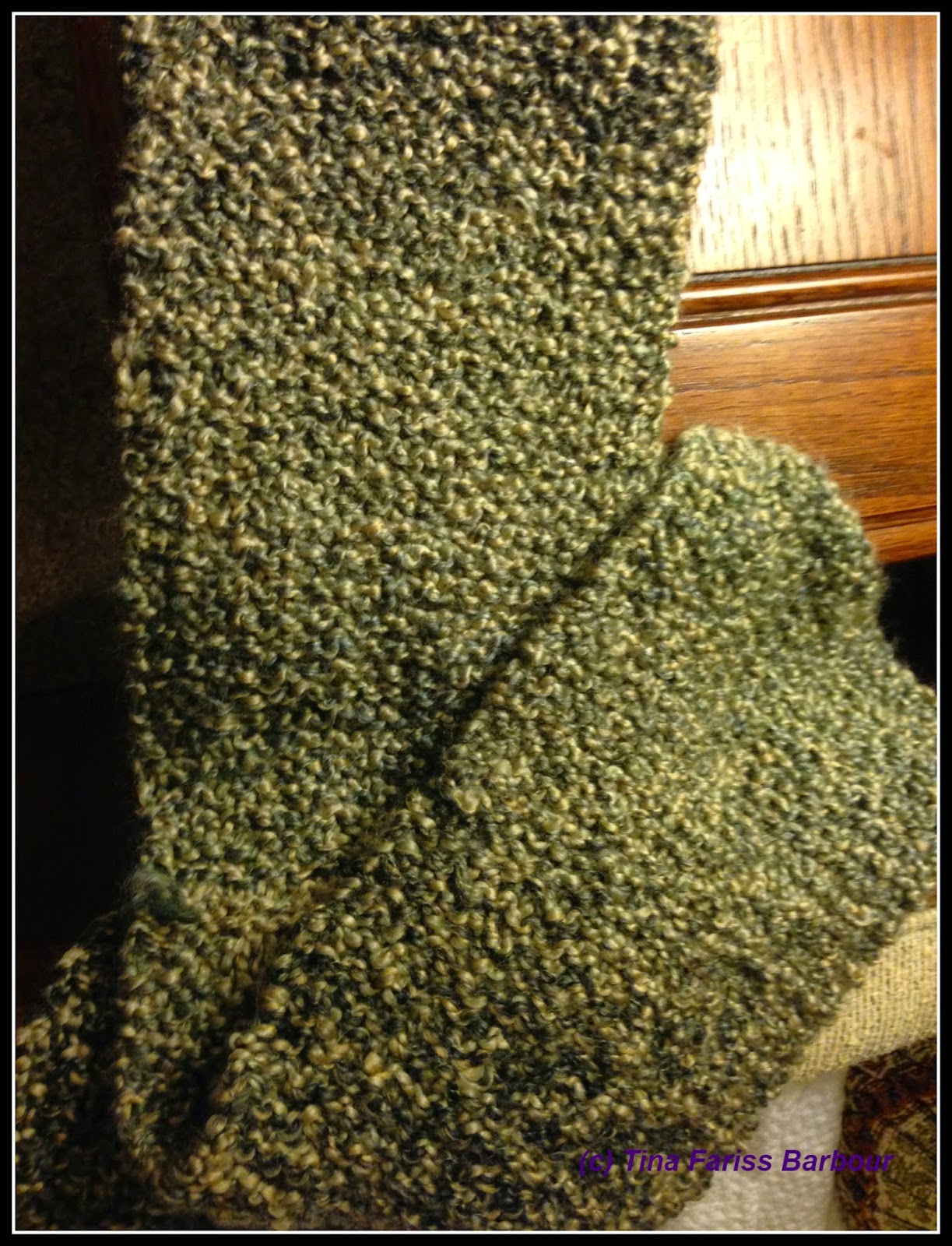
So can knitting. Here is my first knitted scarf:


I love the motions my hands make as they work the needles. I like the way the yarn feels. I like the rhythm. I like having a finished product. I feel soothed.

So that’s where I am right now. Still putting one foot in front of the other, as we all have to do.

Take care of yourselves, love yourselves. And I will see you on Thursday.

Monday, July 14, 2014

The importance of getting treatment for mental illness

Sometimes I get emails from readers of my blog, asking me for advice on how to deal with OCD, other anxiety, or depression.
I am always happy to tell them what works for me. I am not a medical professional, but I do have personal experience with mental illness and treatments. So I try to share.
One thing that I’ve noticed is that not everyone is in treatment or even thinking about treatment.
I’m not going to make a blanket statement and say if you have a mental illness, you need to be in a certain kind of treatment.
But I will say this:

If you are having a difficult time coping with daily life, if life seems dark and just gets darker by the day, if you have intrusive thoughts, if you are abusing substances such as alcohol, if the ways you usually cope with the bad times aren’t working, then I believe you need the help of professionals.


For more information about when to seek help, check HERE and HERE.

When I first got therapy, I didn’t have health insurance. This was back in 1988, and I was a graduate student in Ohio.
With the encouragement of a friend, I contacted student mental health services at my university and started seeing a psychologist on staff. It was the first step in understanding the pain I had been in for years. It was the first step in a very long journey to a new way of being.
I was able to see this psychologist free of charge because I was a student at the university.
Eventually, she told me she thought I needed the help of a psychiatrist for my continuing depression and for the OCD symptoms that I finally revealed to her. She referred me to a doctor in a nearby town.
I paid out of pocket to see the psychiatrist, who gave me my “official” diagnoses of depression and OCD in January 1990. I was 26 years old.
I started taking medication while continuing my talk therapy with the psychologist.
I slowly began to see light at the end of the tunnel.
I moved back to Virginia in July 1990, and it wasn’t easy to get the mental health help I needed. I wouldn’t have health insurance for three more years.
But I worked with what Virginia has, a community system of mental health professionals which I could access on a sliding scale. In other words, they looked at my income and billed me according to what I could afford.
It’s not a perfect system. Not all mental health professionals are created equal. But I got some individual help and even took part in some group therapy.
I went for long periods of time without active therapy. I stayed on my medications and had good times and bad times.
I read Dr. Jeffrey Schwartz’s book Brain Lock back in the 1990s, and that helped me a lot with OCD. I began to learn more about meditation. I read a lot about mental health. I began to understand how spirituality didn’t have to be a hindrance or a burden, but could actually help. I began to understand how my relationships with family members and others hurt me rather than helped me.
Eventually, five years ago, I decided that I needed therapy again, and my family doctor recommended my current psychiatrist to me. He encouraged me to get some help from a psychologist on staff, which I did.
I delved deeper into studying and writing about OCD, and I learned a lot about how the disorder was affecting my life.
My mental health has probably improved more in the past five years than in all the years since I saw my first therapist in 1988.

I know the health care system in the United States is not always kind to those who need mental health services. I am blessed to have insurance that covers such care.
I encourage anyone who is having a difficult time mentally to reach out for help. To find referrals to mental health professionals, you might want to start with your medical doctor, a social worker, a teacher, or a minister or rabbi or other spiritual leader.
Make sure he or she is someone you trust and who understands the needs of those with mental illness. Walk away if they don’t take you seriously or try to minimize your problems.
Look on the Internet for help. For example, on the website of the International OCD Foundation, you can find a lot of information about OCD as well as a database of therapists who can help those with OCD.
Other online resources for finding treatment providers include Mental Health America and National Alliance on Mental Illness.

The right treatment can put you back on track. It can enable you to live the life you want to live.
That’s what it did for me.

Note: Where have my photos gone? I haven't been taking many photos lately, but I am working to change that and will have photos with my posts again!


Wednesday, January 30, 2013

It’s worth saying again and again: You can get relief from OCD

If you have obsessive-compulsive disorder or think that you do, there’s something that I want you to know: you can get better. There are treatments available. You can get relief.
I’ve said that before. I hope it’s a belief that permeates my blog.
But it’s worth saying again. And again. As many times as it takes to make sure you know, deep down: you can get better.
Earlier this week, I wrote a post describing a day with OCD and other anxiety. The day I wrote about was stressful and full of anxiety, but it wasn’t the worst day I’ve ever had.
I started to think about those of you who have worse days than that quite often. And I felt compelled to write this post.
Before I got any treatment, before I even told anyone about my symptoms, OCD had come to rule my life.
I was in my 20s when I first got treatment for OCD.
Before then, I spent hours at a time scrubbing my bathroom over and over.
I checked my stove until the early morning hours to make sure it was turned off.
I couldn’t read a book because of reading OCD, which made life as a student very difficult.
Every time I walked anywhere outside, I slowed myself down by checking every stick and stone that looked like it might harm someone else.
I prayed compulsively for God’s forgiveness and worried about my eternal salvation.
My hands were dark red and incredibly dry from excessive hand washing.
My life was hell. I had no hope that I would get better. I didn’t want to live.
But a friend encouraged me to see a therapist by revealing to me that she was in therapy.
I started seeing a therapist who I learned to trust. She referred me to a psychiatrist, who diagnosed me with OCD and depression and started me on medication.
Through the years after that, I also learned new ways of dealing with OCD and my thoughts and actions by reading and researching OCD, from cognitive behavior therapy, from exposure and response prevention, by reaching out to others with OCD, from writing about OCD, from meditation and from learning more about myself.
I am better today, so much better than I was when I was first diagnosed more than 20 years ago. And I have hope that I will continue to get better and learn to live a life at peace with OCD.
Here are some resources to help you learn more about OCD and the treatments available:


Here are two books that especially helped me:
Brain Lock: Free Yourself from Obsessive-Compulsive Behavior. By Jeffrey M. Schwartz, MD, with Beverly Beyette.
Freedom from Obsessive-Compulsive Disorder: A Personalized Recovery Program for Living with Uncertainty. By Jonathan Grayson, Ph.D.

Remember that you are not alone.
I encourage you to reach out and get help if you haven’t. I encourage you to keep on fighting to get better.
I encourage you to get some relief.

What are some things we can all do to encourage others who have mental illnesses?

Friday, December 28, 2012

Looking back at 2012

I’ve been thinking about what kind of year 2012 has been. I guess it’s not unusual to do that as the year winds down to a close and the new year begins in just a few days.

As I thought about the themes of this blog—living with obsessive-compulsive disorder while also dealing with depression and anxiety—I kept coming back to what has played a big role in my life this year: therapy.

I thought about the many times this year that I’ve climbed the front steps and walked into the red brick building where my therapist and my psychiatrist have their practices.

I have spent hours in their offices, feeling the gamut of emotions: fear, anger, joy, sadness.

I’ve talked, I’ve listened, I’ve role played, I’ve wept.

I’ve heard things and learned things that have reached my very core.

I had been away from any type of therapy other than “medication checks” with my psychiatrist for many years, but I had the goal of starting exposure and response prevention therapy, or ERP therapy as I started the year.

I had my first appointment with my psychologist in January. At that time I discovered that we would do cognitive behavior therapy instead of strictly ERP therapy, which was fine with me.

My therapist and I worked on my OCD for a while, and I made headway in learning to accept and deal with anxiety instead of doing compulsions to try to lessen it. I did ERP exercises and reported back to my therapist.

The therapy took a turn in April when my therapist noted that my depression—which he diagnosed as chronic—was affecting my ability to deal with the OCD and other anxiety.

We started CBASP therapy, Cognitive Behavioral Analysis System of Psychotherapy. It’s made up of intense sessions using situational analysis. These sessions have chipped away at the anger and subsequent helplessness that feeds the depression.

In October, I decided I needed to simultaneously work more on the OCD, so I started doing more ERP on my own, using as a guide Dr. Jonathan Grayson’s Freedom from Obsessive-Compulsive Disorder: A Personalized Recover Program for Living with Uncertainty.

Compared to this time last year, I feel like I’ve moved down the path towards real recovery. I deal better with my interpersonal relationships, my OCD is better under control and I feel hope that I’m going to get better.

All this has reminded me of the importance of treatment for OCD and for depression and anxiety. There are many kinds of treatment, and each person is different. Different things may work for different people. The point is to reach out and get the treatment that is right for you.

I plan to continue climbing up those front steps in 2013.


What are some of the things 2012 has taught you?

Wednesday, October 17, 2012

Depression and expressing my needs and wants

I carry an ideal around in my head about what I should be able to accomplish: I should be able to be told something once, understand it once, and then never have to be told again.
Real life doesn’t work that way, of course, and the hardest lessons take time and repeated instruction.
I have found that out in the therapy that I’m undergoing for chronic depression.
I’m still having difficulty in expression my needs and wants to others.
Now, my therapist doesn’t want me to turn into a self-centered, selfish person who cares only about my own wants.
He doesn’t want me to become demanding or shove my wants down someone else’s throat.
But he does think it’s important to my emotional development and to my depressive moods for me to learn that my needs and wants are important.
Through my upbringing, I learned that my needs and wants were not important and I was selfish and spoiled to want them considered.
Even though intellectually, I know that people’s own needs and wants are important, even my own, I don’t accept it emotionally.
And therein lies my problem.
I recently failed once again to tell my husband what I was really feeling about something, what I was really wanting. It wasn’t over anything earthshaking, but it was important enough that I needed to express myself.
Instead, I resisted, and then later when my husband asked me what was wrong, that I seemed far away, I answered with my old standby: “I’m tired.”
I wasn’t making that up. It wasn’t like I was full of energy and raring to go. I really was tired. But I was tired with the fatigue of depression more than the fatigue of work.
My therapist said that when I don’t speak up about my needs and wants, I might avoid conflict. But I push the feelings down.
“And who keeps score?” he asked.
“I do,” I said.
“Your body does,” he said.
When I’ve acted in a way that is consistent with helplessness—not expressing myself, believing that it’s not important, believing that my needs and wants are not important—then I feel helpless.
That shows up in my body with a depressed mood and fatigue.
What can change that? My behavior.
I have to act like I’m not helpless. I have to express myself. I have to act like my needs and wants are important, even if emotionally I don’t yet get it.
If I watch closely, my therapist told me, I will begin to notice that when I don’t express myself, my mood is lowered. When I do begin to speak up, my mood will be better.
The brain is a social organ. Interpersonal relations affect how I feel, he said.
So once again I’m learning that my behavior can make a huge difference in how I feel.

  Do you have a difficult time expressing your needs and wants? How does that affect how you feel?

Monday, August 27, 2012

Top 5 things that have helped my OCD

I have put together a list of things that have helped me most with my obsessive-compulsive disorder.
Other things have been of help to me, including meditation. But the following list includes what has been most important.
Not all of these things are for everyone. For example, I realize that medication is not the right choice for everyone. But these are the things that worked for me.
Once I made the list, I couldn’t rank them. I couldn’t say for sure that one was more important than another in helping me control and live with the obsessions and compulsions. So here’s my list, in no particular order.

Medication

Medication changed my OCD from being debilitating. With medication, I was able to consider that there might be ways to live with this disorder.
I have had to try different medications through the years, mostly because of my co-morbid diagnosis of depression. It’s not an easy thing, to change medications, to wait for them to work, or not work.
But it has been worth it to be able to gain some distance from an all-consuming OCD to an OCD that I can work with.
I’ve written more about my medication journey here.

Therapy

I’ve had talk therapy through the years, but the therapy that has helped me the most has been the practical cognitive behavioral therapy that I’ve had this year.
While it’s not been the formal exposure and response prevention therapy, it included exposures and the whole philosophy of learning to tolerate the anxiety and moving beyond it. The exposures my therapist led me in were helpful and instructive.
While the CBT got waylaid because of other therapy needed for my depression, I look forward to getting back to it. In the meantime, I’ve been doing some of my own exposures.

Brain Lock

I first read Brain Lock: Free Yourself from Obsessive-Compulsive Behavior-A Four-Step Self-Treatment Method to Change Your Brain Chemistry, by Dr. Jeffrey Schwartz with Beverly Beyette, in the 1990s, and I worked on its principles on my own with some success.
The book taught me to walk away from compulsions even though I was feeling intense anxiety, and I learned that the anxiety eventually died down.
I wrote in detail about how I use “Brain Lock” in this post.

Adopting a cat

Adopting Waddles in 2000 changed my life in many ways. One of the ways was to give me almost constant exposures for my contamination OCD and my hyper-responsibility OCD, though I would not have known to call them exposures.
I learned to live with an animal and clean up messes without freaking out. I learned the joy of responsibility, which began to outweigh my fears of responsibility.

Learning that I wasn’t alone

From finding out a person I really respected and liked had OCD to starting a blog and connecting online with others who have OCD, finding out I wasn’t alone in my suffering has been a big component of my OCD improvement.

What has helped you the most in your battles with OCD and other anxiety?

Friday, August 24, 2012

Breaking through fog: therapy lessons

http://en.wikipedia.org/wiki/File:V%C3%A9theuil_dans_le_brouillard.jpg


It worked out this week that I saw both my psychiatrist and my psychologist, and I had helpful sessions with both. But I still feel like I'm trying to break through fog.

The psychiatrist


I discussed my increased anxiety with the psychiatrist Wednesday, and he was concerned because of the sense of dread I was experiencing and because I had reached the point of starting to fear driving, like I did a few years ago when I was in the midst of the worst anxiety I’ve ever had.
So he decided to take me off of one of the medications, Wellbutrin. It could be having unintended consequences, especially in combination with another medication.
It’s a balancing act to not tinker with the medication enough to allow the depression to get worse, and yet help the anxiety. It’s trial and error sometimes, and that’s not always easy to deal with, especially for an impatient person like me. I just have to wait and see.
At least it won’t be long. He said I should notice a difference by this weekend if it was going to have an effect. Here’s hoping it will help.

On an added note about the anxiety, I’ve been listening to a mindfulness CD by Jon Kabat-Zinn, and it has helped me to be able to fall asleep fairly quickly each night. I’ll write more about the CD and what I’m learning in a future post.

The psychologist


My psychologist and I, as usual, did a situational analysis yesterday, and this led to a discussion about anger, fear and anxiety.
I don’t express anger very well. A lot of the time, I don’t express it at all.
In the particular situation we discussed, I was feeling anger but interpreted my feelings as fear. I never expressed my anger in words.
My therapist said the bodily reaction to anger and anxiety is the same. What I’m not always recognizing is that I’m feeling anger. I recognize it as fear. I then fail to verbally express my anger in healthy ways.
I also tend to think of anger as something bad, something I should feel guilty for feeling.
Something that my therapist told me that was helpful was to think of the motivation for anger and the method of anger.
A motivation for anger might be the fact that you care about someone. A method for showing that anger might be yelling. No one likes to be yelled at. That’s not an appropriate way to express anger.
But the fact that you yelled doesn’t negate your motivation for the anger. You can apologize for yelling, but you don’t have to feel guilty for being angry.

I certainly don’t want to hold on to anger. I just want to stop feeling like I’m a bad person because I sometimes get angry.
It’s all in the balance.

  So that was my week in therapy. To say that I’m frustrated at having to work on these issues at my age is an understatement. I know such issues have no age limit. But I’d have thought I was past them.
  I’ll just keep plugging along, going forward.

Do you ever get frustrated at your progress to become a better person, improve in a skill, or make a positive change? How do you handle it?

Monday, August 13, 2012

Update: my 50th year

About two and a half months ago, I started my 50th year with some plans. I thought I’d update you on how I’m doing.

My therapy is continuing. My therapist wants me to make weekly appointments through at least October for the CBASP for chronic depression.
I hope then we will have done enough work that I can focus more on cognitive behavior therapy for the obsessive-compulsive disorder.
My therapist and I are already seeing results from the CBASP therapy, so I feel like my time with him is well spent.
And my own efforts with the OCD, with encouragement from my therapist, are helping me.

One of my 50th year goals is to get in better physical shape. I am using the plan to participate in the Giblet Jog 5K, on Thanksgiving Day to inspire me. I’m scared to death to participate in a race—I never have.
And I’ve started my “training”—if you can call it that—very slowly, without consistency.
So I’ve got some work to do within the next three months.

Another one of my goals for my 50th year is to finish a draft of my first book. I’m not aiming for a perfect draft or the last draft, but a first draft.
I have finally written down details of how I’m going to accomplish this.
I will be continuing the writing that I’m doing now—scenes, vignettes and stories—until Nov. 30. I’ll use December to go through everything and find a structure. Then I’ll start the actual draft in January and have it finished by May 30, my 50th birthday.
Keeping to this schedule will mean early mornings and late nights, but I am quite determined to get it done.

To accomplish these goals, I’ll have to fight the procrastination that seeps into my activities. I’ll be writing more about procrastination in a future post.

If you’ve been reading my blog, you know that a few weeks ago I decided go from posting every weekday to posting three times a week.
That didn’t work out. I just seemed to have more to say than three posts a week could take care of.
I’ve decided to compromise with myself. I will post Monday, Wednesday, Friday and Saturday. That will give me some breathing room while also giving me the time for doing something I love so much, blogging.

Are you working on some projects that you’ve set goals for? What would you like to share about them? Do you have any advice on how to stick to goals?

Friday, August 3, 2012

A way through anxiety: Accepting ourselves

Imagine you’re holding an ice cube in your hand.
You concentrate on the sensations doing that causes.
Eventually, you begin to have thoughts unrelated to the sensations, thoughts like, “This is really uncomfortable,” or “How much longer do I have to do this?”
When those thoughts come, you notice them, acknowledge that you have them, and then go back to concentrating on the sensations of holding an ice cube.

Acceptance

That is an illustration that my therapist used to explain acceptance in terms of generalized anxiety disorder or any anxiety.
On my last visit, I told him about the increased anxiety I’ve had lately. I’ve felt revved up and unable to settle down and concentrate.
So he talked to me about accepting my anxiety. He said it’s not the same thing as liking the anxiety.
And it’s different from actually making the anxiety worse by worrying about the bodily sensations of anxiety, worrying about worrying, “catastrophizing” the fact that we feel anxious.
We can practice acceptance by focusing on the bodily sensations that come from feeling anxious. When an unrelated thought comes along, we can acknowledge it but then return our attention to the sensations.
With this mindfulness, we can begin to accept that our body is expressing anxiety.
Acceptance is to acknowledge what we’re experiencing and then to go on to something else.
Ironically, that makes the anxiety easier to deal with, my therapist said.

Mindfulness

The ice cube example also helps to illustrate the importance of mindfulness. We can choose to focus on our anxious feelings, but I’ve learned that we can also choose to focus on something like the breath, or our senses.
Every time we realize we’re thinking of something other than the breath or what we’re hearing, for example, we can bring our attention back. Usually I have to do this again and again
That puts me in the moment. It takes me away from my worries. It takes me away from worrying about my worries.
And even a little while away from the worries provides me with relief. And a little more acceptance.

What about you? Does accepting the anxiety make sense to you?

Thursday, August 2, 2012

They do go together: Depression and gratitude


What do I have to be thankful for when it comes to depression? Quite a bit, I discovered, when I sat down to make a list.

*I am thankful that I am being treated for depression. Before I was diagnosed with depression, before I was treated, I lived in a gray and brown world. That’s the way things seemed: no color, little light, dull and lifeless. Hopeless. Though I’ve had periods of depression even after I started treatment, even though I have bad times, I’ve never fully returned to that gray and brown world.

*I am thankful for the treatments that are available. I’m thankful for the medications and therapies that have been developed for use with depression. I’m thankful for the intelligent minds and compassionate hearts that have tried to find ways to combat this disease.

*I’m thankful for doctors and therapists that have helped me in the past and today. I’ve had some bad luck with providers, but overall, I’ve had some good ones, and a few excellent ones. Right now, I have a couple of excellent providers who help me weather the depression.

*I’m thankful that I can afford to pay for medication and therapy. I’m thankful I have health insurance to help me do that.

*I’m thankful for close friends who have listened to me through the years and offered support and encouragement without judgment. I’m thankful for the blogging community and the friends I’ve made through blogging. I have received so much inspiration and hope.

*I’m thankful for my cats. Their presence is always a comfort, and they teach me about love and life every day.

*I’m thankful for my husband. My world is beautiful for knowing him and having him in my life. He loves me, depression and all. I love him.

*I’m thankful for the hope in my heart. I hold on to that hope when the darkness comes around.

What is one thing you are thankful for today?

Thursday, June 14, 2012

Book Review: Depression: A Guide for the Newly Diagnosed

Depression: A Guide for the Newly Diagnosed. By Lee H. Coleman, PhD, ABPP. New Harbinger Publications Inc. 2012. 166 pages.

Note: I was provided with a free copy of this book by New Harbinger Publications and asked to write a review on my blog if I felt comfortable doing so. The opinions in this post are my own.

Depression: A Guide for the Newly Diagnosed is a well-written, engaging book that would not only be of help to the newly diagnosed, but to those who have long been diagnosed with depression.
While I am not newly diagnosed, I found it helpful to review what depression is and what treatments are available. I found good information in the sections on how people can help themselves and how they can ask for help from others.
Lee H. Coleman, PhD, ABPP, writes in a straightforward manner without a lot of jargon. It’s a book that would be accessible to most readers picking up the book to get help with their own depression and for family members and friends of depressed persons.
It is truly a guidebook, because it details the journey from experiencing the first symptoms of depression to lifestyle choices that help in the aftermath of a depressive episode.
Coleman stressed the importance of treatment for depression. In fact, it’s his main point: “If there’s just one message you take away from this book, it should be that depression can and should be treated” (p. 10).
He notes that most people who get treated for their depression get better and do so more quickly than people who don’t get treatment.
He advocates getting the treatment that works best for the depressed person as an individual, stating that less than half of depressed people get a proper diagnosis and treatment.
His rallying cry is to keep on seeking a treatment that works: “If you were diagnosed and treated properly but your depression still didn’t remit, don’t despair! Depression can be tenacious, and what works for one person might not work for another. You’ve got options, and there are different kinds of treatment you can pursue . . . (p. 11).
He doesn’t advocate any one treatment, but he speaks of his own experience in using different treatments with patients and also refers to scientific studies that have been done on the treatments.
Those he discusses include psychotherapy, cognitive therapy, cognitive behavioral therapy, interpersonal psychotherapy, psychodynamic therapy, mindfulness-based treatments and medication.
The book also discusses what depressed people can do to help manage their symptoms while they are in the midst of treatment. I found this chapter to be particularly unique and helpful. The author makes it clear that “these strategies are ideas for symptom management, not symptom removal” (p. 71).
He provides ideas on how to manage low energy and fatigue, the loss of interest and social isolation, sad moods, sleep disturbances, changes in appetite, guilt and problems with concentrating and making decisions.
This commonsense approach to symptom management would be helpful to the depressed person who is not yet seeing results in therapy and/or from medication.
He does an excellent job in describing what a new patient should expect from therapy. This would be particularly helpful for those who have never experienced therapy and for those who may have had a bad experience with therapy and still have some concerns about it.
Coleman underscores the seriousness of depression by devoting a chapter to managing suicidal thoughts, with a section for the depressed person and a section for the depressed person’s family and friends. He includes sections on decreasing the risk of suicide, increasing protective factors, and how to let others know help is needed.
He includes an amazing chapter on resources. It’s one of the most detailed resource lists that I’ve seen in such a book, and I plan to keep it handy for my own research and guidance.
The book includes the Patient Health Questionnaire (PHQ-9) for readers to take and show their physicians to have the number and pattern of symptoms checked.
I wholeheartedly recommend this book for the newly diagnosed. And I also recommend it to those who have been diagnosed but want to read more deeply about what treatments are available and things they can do for themselves to manage their symptoms and decrease the chances of a relapse or recurrence.

Friday, June 8, 2012

7 things I've learned about treatment for OCD and depression

http://en.wikipedia.org/wiki/File:Claude_Monet_025.jpg

*A combination of tools works better than any one thing.
My treatment has included medication, talk therapy, cognitive behavioral therapy and CBASP, and well as self-treatments such as exercise, yoga, meditation and relaxation techniques.
None of these by itself has been enough. And that’s OK. I know there’s no magic pill. And I like the idea of a synthesis of treatments working for the good of my health.

*You’ll notice improvements before anyone else will.
  My first signs of improvement were so subtle that I thought perhaps I was imagining them. I felt a little less down, had a little more energy, was able to stop washing my hands a little more quickly, didn’t check the stove as long.
But I noticed them. Maybe no one else could see a change, but I did. And my therapists and doctors needed me to tell them of any improvements.

*At first, you won’t necessarily see the connection between the treatment and improvement.
My therapist told me that people tend to not want to believe that medication, for example, is the reason for the improved symptoms. It’s hard for us to make such a connection. A pill can help me not have obsessive thoughts? A pill can help me feel less hopeless?
I’ve found that to be true of medication and with the CBASP. I’m feeling better, but it seems like it is a little too good to be true.
And it’s hard for me to see the forest for the trees, so to speak. Therapy is intense and detailed. It’s hard sometimes to lift my head and see the results.

*It’s not easy.
The CBASP is hard. ERPs are hard. Dealing with medication side effects is hard. It takes dedication and discipline to keep doing the things that will make me feel better.
And there’s the fear of failure. Sometimes during a therapy session, I worry that I’m not doing it right, that it’s not going to work.
That’s when hope is so important.

*It’s usually not a quick process.
  I’ve been in treatment of some kind, even if it has just been medication, for 22 years. That’s hard to admit because there’s a part of me that believes I should have gotten it right by now. But that brings me to the next point.

*It will never actually end.
  Treatment for OCD and depression will go on indefinitely because there is probably no cure, only remission, by which I mean a lessening of symptoms. Even when I’m no longer in active therapy, the exposures will continue, the self-talk and learning will continue.

*Any treatment works better if you take care of yourself in basic ways.
It’s important for me to get enough rest and to eat properly. If I get very tired, I first get very anxious, then I crash and get more depressed.
If I eat too much or too much junk food like sweets and simple carbohydrates, I feel sluggish and my stomach bothers me, which in turn makes less energetic.
And having time for myself to read, think, and just relax is key to me being better able to handle what life brings.

What have you learned about treatment for OCD and/or depression or other mental illness? What suggestions do you have for others going through treatment?